When G7 Leaders met in Kananaskis, Alberta, Canada in June 2025, they committed to promote economic prosperity by supporting small- and medium-sized enterprises (SMEs), including micro-enterprises, to adopt artificial intelligence (AI). There is broad agreement that adopting AI can boost productivity, unlock innovation, and foster economic growth. AI is a transformative general-purpose technology, which, like electricity or the steam engine, can be applied to many different economic activities and is therefore anticipated to have widespread economic and social impact. Accelerating and broadening AI adoption to enhance productivity and prosperity is a key priority of G7 countries.
Adoption of AI by SMEs is a cornerstone of efforts to realize its economic potential. Overall, AI adoption is still in its early phase, with the technology's diffusion rate remaining low compared to other digital technologies. Although an increasing number of SMEs are adopting AI, across all G7 countries their adoption rate lags that of large enterprises. Sectoral differences are also pronounced. Uptake is concentrated mainly in knowledge-intensive sectors, with information and communication technologies (ICT) and professional services leading in adoption, followed by professional, scientific, and technical activities sectors.
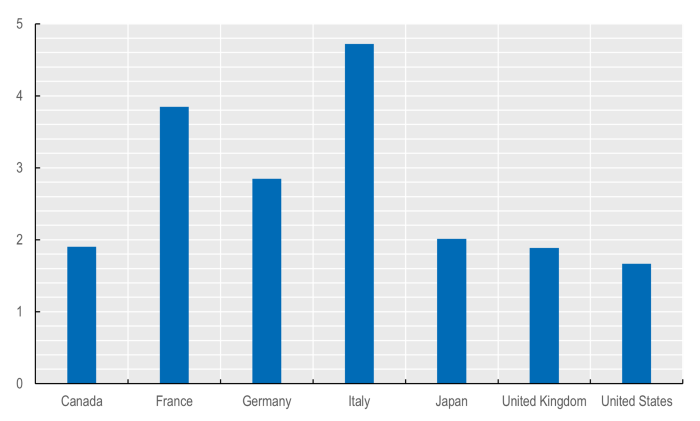
Figure 1: AI adoption rates have been increasing across all G7 countries (see also text version below)
Latest available AI adoption rates from national sources, G7 countries
In Germany, 28.2% of medium-sized companies (50–249 employees) use AI compared to just 16.9% of small companies (10–49 employees), while in France and Italy the rates are even lower, with small companies under 10% and medium companies around 14–15%.
In Japan, about 16% of SMEs report using AI, while in the UK adoption among small and medium companies ranges from roughly 8–10% up to 23–26%, depending on the survey methodology.
In Canada, about 12.5% of smaller companies have reported using AI, while in the United States the latest official data put adoption at 3.4% among very small companies (10–19 employees) and 4.8% among medium-sized ones (100–249 employees).
By comparison, larger companies (250+ employees) have a higher adoption rate. For instance, large companies in Germany, France and Italy are adopting AI at 48.2%, 32.7%, and 32.5%, respectively. In the UK, adoption rate ranges from 13% to 28%, depending on survey methodology, and in the US it is at 7.2%. For Canada, it is at 17.9% for companies with 100+ employees.
Divides are also sectoral
ICT and professional services exhibit adoption rates far above average, while construction, hospitality, and transportation remain in the single digits.
Manufacturing, transportation, construction, and agriculture have lower levels of adoption due to legacy systems, limited digital maturity, and a lack of internal AI expertise.
ICT, software, health, and financial services sectors lead in AI adoption due to their digital infrastructure, in-house technical expertise and a culture experienced in adapting innovation into business practice.
Figure 2: AI adoption gaps between larger and smaller firms (see text version below)
To fully deliver on AI's potential, it is important not only to increase AI adoption by SMEs but also to ensure its effective integration at the company-level, so that adoption translates into meaningful productivity gains. SMEs that adopt sound internal strategies that align AI adoption with their business models and organizational capacities can gain a distinct advantage. All too often, adoption remains at a nascent or pilot stage: companies experiment with AI tools but face hurdles embedding them into core operations, leaving productivity gains unrealized. Structured plans that connect AI tools with business tasks, functions, goals and outcomes appropriate to each business's size and sector, are the key to extracting the most from AI adoption. Furthermore, SMEs that empower their workforce to effectively use, interact and innovate with AI systems can benefit across a breadth of applications. With the right supports, SMEs can help their workers to actively co-design AI adoption strategies, ensuring that integration aligns with their day-to-day functions and enhances their roles. However, if strategic company-level planning is not ready, AI risks remaining a peripheral tool rather than a driver of competitiveness.
To create winning conditions for SMEs to thrive in this evolving environment, key challenges must be addressed. At the ecosystem-level, SMEs remain constrained by longstanding barriers, such as infrastructure gaps, limited access to talent, capital and capacity and regulatory and governance uncertainty. These conditions slow their ability to experiment, scale, and integrate AI into core operations. At the company-level, many SMEs lack data that is AI-ready or face challenges preparing their data for AI use. They also experience challenges defining use cases, assessing returns on investment, and managing risks, which can prevent them from moving beyond pilot projects. For many, cultural barriers and internal resistance further complicate adoption.
Barriers to AI adoption are compounded by SMEs' day-to-day challenges. Increased commercial rents, inflation, reduced consumer spending, and global trade uncertainty present immediate pressures that compete with long-term innovation plans. Faced with these realities, many SMEs miss the time, capital, or bandwidth to dedicate to processes that carry uncertainty or are resource-demanding.
Smaller companies face notable disadvantages
There is evidence that smaller companies face notable disadvantages in AI adoption compared to larger companies.
Extensive international reviews confirm that while both SMEs and large companies see AI's potential value to business operations, SMEs struggle more with financial constraints, organizational resistance, system complexity, and skill shortages.
Small companies are often unable to spread AI costs over larger sales volumes in order to reduce unit costs, unlike large companies.
Small companies often lack sufficient resources to offer competitive salaries that help attract and retain talent. In a competitive labour market, this puts them at a disadvantage compared to larger companies that are able to invest in talent.
Key challenges faced by SMEs
Connectivity
High-quality and reliable broadband infrastructure and affordable broadband
Key challenges
Digital divide between large and small companies in terms of access to high-speed broadband is an ongoing issue.
Access to high speed and reliable broadband is particularly pronounced for rural, remote, and underserved areas.
AI Infrastructure
High-quality data, scalable platforms, and robust AI tools
Key challenges
SMEs often lack AI-ready data, face integration issues, or deal with fragmented systems.
Infrastructure availability and affordability gaps as they relate, for instance, to compute, cloud, or advanced software are major obstacles to experimentation and scaling.
Business Strategy & Culture
Strategic planning, executive support, and agility to drive change
Key challenges
Lower AI literacy can hinder strategic alignment and decision-making.
SMEs report struggling to define use cases, assess returns or move beyond pilots.
Resistance to change, fear of job loss, or lack of change
Skilling, Reskilling, Upskilling & Talent Development
Access to AI expertise, skill development, and workforce readiness
Key challenges
Shortages of technical talent and cross-disciplinary expertise can be major AI adoption barriers for SMEs.
Gaps in basic digital competences that constitute the building blocks for any AI-driven transformation.
Financial Support Mechanisms
Access to capital, flexible financing options, and affordable AI tools
Key challenges
Before return can be realized, SMEs face incremental costs associated with acquiring AI-ready infrastructure, software and talent.
SMEs typically experience more limited access to bank loans and venture capital.
Regulatory & Governance Guidance
Risk management, data security, and alignment with ethical and legal standards
Key challenges
Regulatory uncertainty and limited technical expertise can make SMEs hesitant to experiment with AI.
Summary of key principles
Tailor Broad and Flexible Policies to Match Diverse SME Profiles SMEs vary by sector, size, digital maturity, stage of AI integration and needs and ambition.
Policies should be broad and flexible enough to accommodate this diversity and implementation should be tailored to specific needs using tools like the OECD's Taxonomy of AI Adopters.
Engage all Ecosystem Actors AI adoption success depends on collaboration.
SMEs, business communities and governments each have roles to play: from building their awareness and capacity, to helping pool resources, to enabling access to resources and to leveling the playing field.
Foster Dynamic and Inclusive AI Ecosystems Dynamic ecosystems with multiplier effects can positively shape AI readiness and resilience.
Investing in infrastructure, skills and startups can reduce upstream costs for AI developers, increase availability of AI tools and reduce adoption risks and costs for end user SMEs.
Promote Secure, Responsible and Trustworthy AI Secure, responsible and trustworthy AI builds confidence and protects stakeholders.
Adoption strategies should align with principles of security, accountability, and risk mitigation, benefiting workers and sustaining market trust.
Account for Broader SME Economic Pressures SMEs face compounded challenges and greater relative risks than larger enterprises.
Policy design should consider real-world constraints like inflation, trade disruptions and capital limitations that impact SMEs more than larger enterprises.
Key principles
In designing strategies to accelerate SME AI adoption, G7 countries should keep the following principles in mind:
SME profiles are diverse and vary significantly by sector, size, resources, digital maturity and growth aspirations, which means that their AI adoption journeys can range widely in both complexity and ambition. For some, the first step may be as simple as acquiring an off-the-shelf generative AI product to automate a routine business function; for others, it may involve developing sector-specific custom solutions that require specialized datasets, in-house technical teams and long-term investment. Likewise, while many SMEs only need to build a base level of AI literacy and buy-in among leadership and staff to begin experimenting safely, others need to grow and sustain extended internal capabilities, including embedding data scientists, engineers and applied AI specialists holistically across their operations. This breadth of adoption pathways underscores two key implications for the design of effective policies and measures aimed at supporting SME AI adoption.
First, policies should be broad and flexible, to account for the heterogeneity of SMEs and to allow for tailoring across different sectors and business journeys.
Second, implementation of policies should be tailored to align with companies' specific profiles, needs and ambitions – rather than following a one-size-fits-all model. In this regard, frameworks such as the Taxonomy of AI Adopters, developed by the Organisation for Economic Cooperation and Development (OECD), can be valuable instruments to inform the tailoring of policies (see Box below).
Businesses, business communities and governments all have key roles to play in creating winning conditions for SMEs. Measures taken to address barriers both at the ecosystem and company-level can enable SMEs to access, adopt and master AI in ways that drive value and productivity growth. Broad engagement can enhance the design of policies and measures supporting SME AI adoption, to ensure that they are grounded in the lived realities of SMEs, and are practical and impactful.
Companies. SMEs are central to the economic transformation that AI applications can bring, but face distinct challenges. As they build their awareness and internal capacity to adopt AI in alignment with their business strategies, G7 countries should look for ways to ease their journeys. They should be fully integrated into every stage of the AI value chain – from adopting AI solutions and developing SME-friendly products, to championing adoption strategies and informing AI governance frameworks.
Business communities, such as business support organizations and sector and industry associations. Business communities are uniquely positioned at sectoral and regional levels to coordinate the efforts of SMEs with aligned interests. They can help pool resources, build awareness, create shared learning programs and build peer-to-peer networks to support AI adoption. These initiatives can create cost savings for SMEs operating with limited margins, while providing access to valuable, sector- and profile-specific resources to guide AI integration.
Governments. Governments at various levels can provide institutional support for AI adoption through investments and programs, including those that grow and support businesses, and governance frameworks that sustain a level playing field for all economic actors, regardless of size. They can also manage frameworks that promote trust in AI and safe and responsible experimentation, deployment and adoption.
With AI adoption still in its infancy, the emergence of dynamic, self-sustaining, and resilient ecosystems will be key to addressing SME gaps and realizing the potential of the technology. By developing innovative offerings, addressing skills gaps and building value chains aligned with SME needs, ecosystems will enable their success. SMEs themselves can play a defining role in building these ecosystems – by adopting AI early, sharing lessons learned and helping commercialize targeted solutions within their sectors. In the near term, measures with known multiplier effects can be effective at catalyzing ecosystem development. For instance, investments in AI infrastructure, data, and talent can, in turn, increase availability and affordability and reduce upstream cost for AI developers seeking to propose novel solutions, such as startups. These investments may also foster startups and promote the emergence of rich and diversified offers that address specialized markets gaps, ensure healthy competition and create a downward pressure on prices seen by end users. Where there is a meaningful effect on the availability of sector-tailored, ready-to-adopt AI solutions that match SME needs, the result will be a lower risk of adoption – thereby, creating demand and dynamizing the overall AI ecosystem.
G7 countries are leading efforts to build enabling ecosystems for AI adoption, underpinned by well-funded national strategies and multi-pronged policy frameworks
Secure, responsible, and trustworthy approaches to AI innovation and adoption are essential to realize its potential in a manner that benefits people, including workers, mitigates risks and negative externalities, fosters ongoing market confidence and promotes security. In this regard, SMEs will benefit from seeking to align their efforts with those principles.
For governments designing policy and program interventions targeting SMEs, the broader context of challenges faced by SMEs should be considered. For instance, SMEs face greater relative risk from increasing cost pressures, economic uncertainty, global trade disruptions and geopolitical uncertainty across various markets and sectors than larger enterprises.
Taxonomy of AI Adopters – Text version: A 2×2 matrix chart showing AI adoption maturity. The vertical axis represents the scope of AI application (Isolated to Enterprise-wide), and the horizontal axis represents AI use complexity (None to Agentic). The four quadrants are labeled: bottom-left 'AI Novices,' bottom-right 'AI Explorers,' top-left 'AI Optimisers,' and top-right 'AI Transformers.' A blue gradient indicates increasing digital maturity from lighter (lower) to darker (higher). Icons represent each quadrant: a chat bubble for Novices, a magnifying glass for Explorers, a checklist for Optimisers, and a starburst for Transformers.
This taxonomy represents the population of SMEs based on the complexity of AI tools they employ and the scope across which those tools are applied. It recognizes that AI adoption is not linear but iterative, and that SMEs vary significantly in their digital maturity. Based on these three dimensions, the taxonomy categorizes companies into four profiles:
AI Novices are companies that are just beginning to experiment with AI, often through embedded features or off-the-shelf tools applied to isolated work functions.
AI Optimisers are SMEs that make more systematic use of AI tools across workstreams, coordinating adoption to improve efficiency and productivity.
AI Explorers are companies that experiment with customized or sector-specific AI application, often in data-intensive contexts, though typically on a limited scale.
AI Transformers are frontier companies that embed AI across most of their operations and decision-making processes, supported by unified infrastructure, data and in-house expertise.
By capturing this spectrum of AI adopters, the taxonomy makes clear that different categories of companies face distinct barriers and opportunities, and that policies must recognize these differences and provide tailored support alongside broad enabling measures.
While this framework is not meant to serve as a universal or permanent approach, it shows how actively assessing the characteristics of SME AI adopters can help strengthen or guide policy development, design and application. For example:
AI Novices are unlikely to benefit from complex incentive structures if they lack basic digital foundations; what they need most are awareness-building measures, affordable access to connectivity and cloud services and entry-level training that can help them take first steps.
AI Optimisers, by contrast, already experiment across multiple workstreams and require support to strengthen coordination – policies that encourage cross-functional integration, promote governance frameworks and provide practical guidance on safe and effective use.
AI Explorers face a different challenge: their ambition to customize AI solutions or adapt them to sector-specific contexts often outpaces their access to compute power, high-quality data and specialist talent. For them, policy interventions that open pathways to shared infrastructure, applied research partnerships, and technical expertise are particularly valuable.
Finally, AI Transformers, which embed AI across their operations, benefit from advanced frameworks that sustain scaling and safeguard responsible innovation.
In this way, the taxonomy provides not only a descriptive map of SME diversity, but also a practical tool for matching the right policy levers to the right profiles, ensuring that interventions are proportionate, targeted and effective.
A critical barrier to AI adoption is the lack of reliable, high-speed broadband, which is foundational to any form of digital transformation. Specific to AI, access to high-quality broadband infrastructure allows companies to access computing infrastructure and employ big data analytics. Only with compute and analytics enabled can SMEs deploy AI applications. SMEs often lack access to high-speed broadband; challenges that are pronounced in rural, remote and underserved areas that may continue to face inadequate internet speeds, unstable connections, and high costs. This digital divide limits the ability of some SMEs to experiment with, implement, and scale AI solutions.
Recommendations
G7 countries should continue public and private investments in broadband infrastructure with a specific focus on rural, remote and underserved areas. Such initiatives should set clear targets for minimum speeds, affordability, and connection reliability that align with the needs of operating AI and cloud-based tools.
Where possible, efforts should be made to lower costs and improve options for SMEs to access the high-quality connections necessary for AI deployment. Consideration may be given to embedding such initiatives within existing regional and industrial development strategies, as a way to help streamline the policy implementation process.
There has been progress in the expansion of high-quality connectivity across OECD countries, including G7 members. This increase in high-quality connectivity is crucial because access to fast, reliable and affordable connectivity is a pre-condition for SMEs' digital uptake.
2. AI infrastructure
Key challenges
SMEs face significant limitations when it comes to accessing critical AI infrastructure, like AI compute and cloud resources. Lack of competition in this area has led to an over-reliance on hyperscalers that can cause the terms of these resources to be restrictive and the costs to be relatively high for SMEs and startups. SMEs also often lack access to quality datasets to effectively train and use AI systems. Internal company data is not always readily available and an SME may not have the resources to collect or prepare datasets of sufficient volume and quality aligned with its needs and context. Securing high-quality data is challenging, yet essential, and the cost and effort of developing AI-ready datasets should not be overlooked. Taken together, for the AI ecosystem to be conducive to SME AI adoption and experimentation, it is important to ensure affordable access to AI compute and cloud solutions, and promote availability of high-quality datasets.
Recommendations
G7 countries should strengthen SME access to AI compute infrastructure. This can include targeted investments focused on developing high-performance compute capacity that is accessible and affordable through shared facilities (such as, AI "factories") to SMEs as well as startups. Removing or lowering prohibitive upfront costs can then allow SMEs and startups to experiment, develop, and deploy AI solutions, which not only increases productivity, but also enables innovation across the value chain.
Where appropriate, G7 countries should enhance access to and sharing of both public and private sector data, on a voluntary basis, including sector-specific datasets, especially in high-risk domains. These datasets should be high-quality, privacy-preserving and intellectual property-respecting, and should be properly de-identified and anonymized where relevant. Data created in one domain and sector can be helpful and provide further value when applied in another domain or sector, especially those where data availability may be limited or constrained. Access to sector-specific data is particularly valuable in high-risk areas – such as healthcare, finance and critical infrastructure – where accuracy, reliability, and privacy concerns are significant. Without robust, representative training data, even the most sophisticated models risk amplifying bias, underperforming and eroding public trust. Investment in high-quality datasets through public-private collaborations can foster a level playing field while maintaining privacy and security.
G7 countries should develop robust and trusted cloud environments. For SMEs, cloud infrastructure is a practical and cost-effective way to access advanced AI capabilities. Unlike large enterprises, SMEs often lack in-house compute, storage capacity or the technical teams needed to manage complex infrastructure. As such, cloud platforms, such as those offering AI-as-a-service, pre-trained models and flexible deployment environments (so that users are not locked in with one provider), can play a critical role in levelling the playing field and enabling smaller companies to experiment, scale and compete in the digital economy. Governments can partner with the private sector to support the development of safe cloud-based systems that ensure secure data handling, compliance with local regulations and interoperability across platforms. In some contexts, public funding can play a role incentivizing SME access, for instance through cloud and compute credits. Measures taken should seek to develop a trusted marketplace where SMEs can access certified AI tools, datasets and services. Additionally, integration with edge computing and hybrid models should be supported to meet sector-specific needs, especially where low latency and data sensitivity are key.
G7 countries should explore how open-source, intellectual property-respecting AI can help lower barriers and administrative burden to adoption and experimentation by SMEs. Open-source AI approaches – potentially including open-source codes and weight models, high-quality open datasets and documentation, open software frameworks, and tools and methods to ensure safe and responsible open-source ecosystems – promise to reduce the costs of access to key resources for AI development, deployment and use. Standardized and royalty-free solutions are particularly well positioned to support these objectives. To ensure trust and continuing relevance, evaluation of open-source AI approaches can consider whether and how these approaches and the ecosystems supporting them are responsibly governed and continuously maintained. In particular, G7 countries should explore how governments and business can partner to support initiatives aimed at building and sustaining such ecosystems, to help level the playing field for SMEs – giving them affordable and trustworthy AI tools to experiment and innovate with.
Once firms have access to digital infrastructure, AI-enabling inputs become critical: data, algorithms and compute
.
3. Business strategy and culture
SMEs are often seeking a clear adoption roadmap that can allow them to strategically align AI systems with existing business processes and workforce capabilities, and progress from experimentation to full scale production. Many companies start their AI journey with optimism through limited-scope pilots or small-scale applications, but they can struggle to scale these experiments or translate them into deep integration. A key reason for this is the relative novelty of AI technologies and their evolving horizon of application. Without baseline AI knowledge, it can be difficult to identify and prioritize high-value use cases, mobilize resources or build governance structures that can scale. This lack of technical awareness can create barriers, making it difficult for SMEs to recognize where AI can genuinely add value or improve their core operations. In such context, companies might remain uncertain about risks and potential returns on investment, leading to hesitation and under-investment in AI adoption.
This uncertainty also reverberates into organizational culture. Many SMEs operate with limited data maturity, legacy infrastructure and a workforce that may not be prepared for new modes of collaboration. Without robust change management strategies and practical support to build trust and equip employees with new skills, AI can appear as a disruptor rather than an enabler. As a result, AI solutions may remain confined to silos and added onto existing processes, missing opportunities for deeper integration that can reshape business models, workflows and decision-making across functions. To fully realize AI's potential, SMEs need to acquire the capacity to treat it as a transformative tool. Internal and external resources can be harnessed to better integrate AI into SME leadership, strategy and culture, so the technology can play its part in a coherent business roadmap for growth and innovation.
Recommendations
G7 countries should help SMEs build strong AI literacy across the organization, from leadership to worker, to enable informed decision-making. This may be achieved through targeted programs that promote technology literacy and diffusion, including frequent learning (e.g., seminars and workshops), mentoring and exchange practices that help executives better identify AI opportunities, prioritize specific AI integration workstreams, allocate appropriate resources and build talent for long-term organizational growth.
G7 countries should encourage businesses to develop AI adoption roadmaps. Company-level roadmaps can bring coherence to AI integration strategies across the organization. A roadmap should align with overall business goals and articulate where, why and how AI will be used to drive value. This may include scoping and setting adoption priorities, assessing data readiness, defining governance structures, highlighting expected return on investment and clarifying resource allocation. Where relevant, businesses should consider phased implementation, particularly in sensitive domains, as a way to help reduce risk and allow for gradual integration of AI into existing workflows while building trust and reliability in AI adoption. Pilots, in particular, can help validate use cases and de-risk scaling efforts across the enterprise. Ultimately, roadmaps can help businesses move from a general interest in AI toward a concrete, systematic implementation plan that drives meaningful integration.
SMEs themselves may need to foster an internal culture of experimentation, cross-functional collaboration, data-driven business operations and decision-making and continuous learning. In this regard, change management is essential to guiding teams through AI integration transitions, addressing opposition, facilitating upskilling, empowering employees, and embedding AI into everyday workflows in a way that effectively augments existing work functions. From a labour force perspective, various public and private organizations can contribute to building trust in AI applications for day-to-day operations, helping workers see AI as a tool for enhancing – not replacing – their roles and as a means to innovate their routine activities.
Where relevant, businesses and business communities should consider co-creating and organizing sector-specific AI adoption roadmaps that put SME needs in the foreground. The process of developing roadmaps would encourage businesses to join or champion AI adoption and learn from peers, identify industry-specific applications of AI, share critical guidance, and understand how adoption pathways converge and differ across contexts. Peer-learning initiative, including workshops, conferences, and cross-sectoral events, can help spread best practices among SMEs and startups.
Successful projects usually begin with tightly defined problems that align with business priorities—such as cost savings, efficiency gains or product improvement. Narrow use cases allow for targeted prototyping and performance measurement. Leadership and teams are more likely to invest when AI is positioned as a practical tool to solve immediate business needs.
AI adoption can often start by building foundational literacy and clarifying the AI adoption journey to support more effective engagement. Effective AI literacy programs should engage technical teams and leadership, while also influencing broader organizational culture through a combination of knowledge-building and practical training.
4. Skilling, reskilling, upskilling and talent development
A barrier to effective AI integration is the lack of adequately skilled talent across an organization. As AI technologies continue to evolve, SMEs often struggle to develop or find workers with the technical, analytical and domain-specific skills needed to effectively implement and use AI. Without skilling, reskilling, upskilling and a strong culture of continuous learning, companies risk underutilizing AI, misinterpreting its insights, or facing labour opposition due to uncertainty and fear of displacement. Investments in talent are key and can aim to equip a broad range of employees with the knowledge and confidence to deploy AI, adapt their roles and drive innovation across workflows. Such efforts also offer natural opportunities to empower workers to co-lead the integration of AI instead of being objects of AI adoption efforts.
Recommendations
G7 countries should invest in measures promoting skilling, reskilling and upskilling aimed at both foundational and targeted skillsets. Foundational AI literacy training can provide everyone a baseline level understanding of how AI works and how it augments everyday roles, while targeted approaches can tailor programs to the specific needs of different sectors, roles and levels within the organization. Strong skills can ensure that all employees are equipped to engage productively with AI in their work context, while avoiding a one-size-fits-all program that fails to meet specific workforce needs.
G7 countries should support pooled or joint training programs that can serve as shared resources, and lower the cost and complexity of skilling, reskilling and upskilling for individual SMEs. This can include programs that address the unique operational and technical needs of specific sectors or industries, programs that deepen SMEs', business communities' and business support organizations' linkages with talent pools such as universities and research centres, and programs that embed AI talent directly within SMEs through internships, residencies or collaborative projects. As well, mentorship initiatives can connect SMEs to sector-expert advisor networks with AI expertise, unlocking access to technical expertise and tailored guidance, supporting internal capacity-building and sophistication over time. Therefore, by combining pooled training and expert networks, resource-constrained companies are able to develop human capital with sophisticated understanding of AI for meaningful integration in their business context.
G7 countries should search for ways to promote ongoing learning and enhance practices that allow AI to be seen as a force for good by SME employees – so they are empowered, not displaced, in the age of AI. In some cases, this can be achieved through on-the-job and modular training. Companies may embed continuous learning into their organizational culture, making AI literacy a regular part of their overall training curricula for their staff. This may incorporate modular, flexible training opportunities – such as through e-learning, seminars and workshops – that fit into the employee's schedule. This may also include leadership by and partnering with institutions such as community colleges and local universities, to build educational programs. Over time, the ongoing learning can empower employees to co-design approaches to integrating AI and use it to drive innovation and career growth. If successful, such practices will produce a cultural shift for labour in the way AI is perceived.
SMEs consistently cite a lack of skills as a major impediment to AI adoption. In an OECD survey covering four G7 countries, 50% of SMEs report that their employees lack the skills to use generative AI.
A skilled SME workforce can help unlock the productivity gains of AI, benefitting SMEs and workers alike
5. Financial support mechanisms
Access to capital and other financial constraints remain one of the most significant and persistent barriers to AI adoption. Unlike larger companies, SMEs often operate with limited margins, making it difficult to allocate resources to AI experimentation, infrastructure and workforce development. Costs associated with acquiring AI-ready infrastructure, licensing software, hiring skilled talent and training staff can often be prohibitive. These challenges are compounded by the longstanding challenges SMEs face in accessing capital, such as bank loans and venture capital. Limited collateral, higher perceived risk, shorter credit histories and lack of clarity on anticipated return on investments are some of the reasons that make it harder to attract investment compared to their larger counterparts. Startups also face specific challenges accessing capital, given their focus on high-risk innovation and rapid growth. Access to capital is also essential to cultivating competitive markets for AI solutions, including the creation of new and innovative AI offerings that benefit SMEs. Governments, businesses and business associations can all play a role in facilitating financing for SMEs, both for adopters and developers of AI solutions, and fostering the development of competitive AI ecosystems calls for tight collaboration.
Recommendations
G7 countries should take steps to further improve SME access to capital and advisory services to enable AI adoption. Growing availability of appropriate financial instruments, such as loans and venture capital, can emerge with a stronger line of sight on AI's benefit to SMEs in the financial sector. Where gaps remain, public guarantees and co-investment models can be structured to reduce the risk to lenders and investors, especially for innovative or newer SMEs. Digital tools and platforms for credit assessment can also alleviate barriers by leveraging SMEs' online presence to demonstrate their financial health. Additionally, advisory services on AI adoption and financial literacy can help ensure SMEs better understand the costs and productive impacts of adoption and are confident in their investments. It can particularly equip them to prepare strong business cases for their investments in adoption and to navigate the funding landscape. Taken together, these solutions can ease access to capital and overcome barriers to allow SMEs to make long-term investments in AI adoption.
G7 countries should also support the development of new, innovative or low-cost AI products and services. Measures can be targeted to promote the emergence of novel AI products and solutions, covering a range of prices, that meet specific SME business needs. Examples include incremental public funding for pre-commercial research and development, and support for SME-focused innovation hubs and incubators.
G7 countries should encourage voluntary sector initiatives and networks that endeavour to pool SME resources to create economies of scale – for instance through shared services models, collaborative procurement, joint purchases of AI licenses and cloud infrastructure access, or joint hiring of specialized expertise. Where relevant, these initiatives and networks should be incentivized to offer centralized resources to their communities of SMEs, such as the latest information on available grants, low- or no-cost AI tools, compliance guides, and best practices for adoption. This can not only reduce costs for individual SMEs, but also promote voluntary collaboration and knowledge-sharing among SMEs, strengthening their capacity to innovate and compete.
Where relevant, G7 countries should encourage bundling of advisory services with AI-related financial support delivered to SMEs. They should leverage trusted intermediaries – such as chambers of commerce, research and innovation centres, industry and sectoral associations, credit unions and local development banks – who can not only distribute loans and grants, but also advice to SMEs. A single, accessible point of contact equipped to guide SMEs through different stages of adoption, from assessing business needs and securing funding to developing strategic integration plans and connecting with trusted AI vendors, can accelerate SME AI readiness.
The Strategic Role of Local Banks in Accelerating SME AI Adoption
Local and regional banks are uniquely positioned to act as catalysts for SME AI adoption. Beyond serving as financing channels, they can operate as trusted partners, combining proximity, financial expertise and ecosystem knowledge to help SMEs navigate the path toward digital transformation. Key roles they can play include:
AI-Ready Financing: Develop and offer dedicated loan products, credit guarantees and flexible repayment schemes designed for AI-related investments.
Advisory and Readiness Support: Integrate AI-readiness assessments and digital advisory services into lending processes.
Ecosystem Conveners: Leverage their community networks to connect SMEs with AI vendors, fintechs, local innovation hubs and government support programs.
Capacity Building: Equip bank advisors with foundational AI literacy to better guide SME clients through financing and adoption decisions.
Data Partnerships: Under appropriate governance and privacy frameworks, explore opportunities for anonymized data collaborations that can improve credit assessment models and inform SME AI applications in forecasting, productivity and financial management.
6. Regulatory and governance guidance
Clear and practical regulatory and governance guidance is essential for effective AI adoption by SMEs. When regulatory uncertainty is coupled with SMEs' limited capacity to navigate complex compliance requirements — for example, on data privacy, algorithmic accountability, security, and transparency — it can either leave companies hesitant to adopt AI due to legal and reputational risks, or lead to the deployment of AI in unsafe or inappropriate ways. Without SME-friendly governance support, businesses may decide not to adopt AI, or may integrate AI in ways that fail to comply with existing frameworks. This will expose them to unnecessary compliance risk or risk of underperforming against competitors that adopt AI more confidently.
Recommendations
G7 countries should develop SME-friendly AI governance guidance and compliance resources. Governments and regulators can create practical and accessible resources, such as simplified compliance lists, privacy assessment guides, toolkits and best practice guides for responsible use of data and AI. Where relevant, these resources should be informed by best practices, such as those recognized through the Hiroshima AI Process. They should be developed collaboratively with relevant sector and business associations to help SMEs understand best practices relevant to their domain as well as their obligations under existing laws.
G7 countries should promote engagement between regulators, SMEs, and SME-focused business associations to inform the creation of regulations and standards that are compatible with the needs of SMEs. Associations are well-positioned to bring the perspectives of smaller companies into government-led regulatory and standard-setting discussions where larger corporations' perspectives may dominate. Engagement can ensure that the perspectives of SMEs are considered in decisions about AI governance and promote regulations that are practical, flexible and scalable for smaller businesses.
G7 countries should keep collaborating to improve compatibility between AI governance frameworks — both within their individual economies and, where appropriate, across the G7 and beyond — to ease compliance burdens. Compatible approaches to data privacy, algorithmic accountability and cross-border data flows can reduce fragmentation, increase the predictability of compliance environments, and lower compliance costs for SMEs operating internationally.
Regulatory and legal uncertainty can be a significant deterrent to AI experimentation especially in sectors like health, finance and environmental monitoring. SMEs may lack in-house legal expertise to assess compliance risks making them hesitant to deploy AI solutions that interact with sensitive data or regulated processes.
A variety of AI use cases organized by AI adopter profiles[5]
The business was already relying on digital tools for online sales. With the rise of generative AI, the company took it one step further – using off-the-shelf products like ChatGPT for multiple functions. This includes "coming up with product descriptions, updating SEO [Search Engine Optimization], writing marketing emails, and analyzing shipping costs." The company is also using ChatGPT to explore ways to automate removal of static build up from grinding coffee, which can be a time-consuming process.
AI Optimizers
2. Small bag manufacturer
A small bag manufacturer is utilizing off-the-shelf AI products to streamline processes.
This SME is employing off-the-shelf AI tools, such as ChatGPT, Gemini and Co-Pilot, as well as machine learning models to automate parts of their workflows. These tools have allowed the company to improve analytics of its production capacities, streamline processes and automate operational flows. While the company has faced some challenges such as integration of AI within the broader ecosystem and better equipping workers with knowledge of AI, the company has benefitted from government's support in adopting AI.
AI Explorers
3. Micro wholesale trade company
A B2B micro wholesale trade company is using custom AI agents to streamline communications and sales.
The company identified several challenges that hinder local manufacturers from selling globally, including "a lack of resources, language barriers, and delays in response times." To address these gaps, the company created custom AI agents to handle Q&As, facilitate project negotiations and power a multi-language translated chat function. The outcome has been positive, with sellers noticing increased revenues and saved time for employees and buyers spending less time on market insights and product development as well as on negotiation cycles due to faster responses and improved communication.
AI Transformers
4. Small biotech company
A small biotech SME is using custom AI tools for drug discovery for rare diseases, to optimize its own processes and bring effective treatments to rare disease patients.
The SME has built its own Machine Learning (ML) models for predicting hidden therapeutic opportunities for rare diseases. These models are based on the company's own "knowledge graph and knowledge base systems for rare diseases, capable of integrating more than 50 relevant structured and unstructured data sources, as well as curated data on relevant diseases and drugs."
Their engineering and scientific staff are also "extensively using LLM-based coding assistants (Co-Pilot, Sonnet, Gemini, etc.) and development tools (Claude Code, Codex)," citing efficiency and productivity gains. More recently, they have started "developing AI agents and AI tools to help in identifying relevant data [for their] drug discovery programmes." For the company's own use, they have also developed LLM-based chat interfaces to make documentation and access to internal data easier for the whole organization.
A variety of AI use cases across sectors and industries[6]
Aviation
A mid-sized commercial charter airline is deploying LLM to process safety reports and investigations.
The airline partnered with a national AI expertise organization on an applied AI research project. Together, they have developed a two-phase AI system. First, they use LLM to process employee safety reports to assess outcome severity and barrier effectiveness. Second, they use agentic AI to run full investigations. The system flags any gaps for human review, maintaining a human-in-the-loop approach. It resulted in significant reduction in manual work time, allowing investigators to validate and improve reports instead of focusing on administrative tasks. Given this success, the airline is launching a spin-off to bring the solution to the wider aviation industry.
Agriculture
A micro-SME has developed a robotic system that automates strawberry harvesting with 95% accuracy, cutting labour costs and advancing agri-tech.
The company collaborated with a subnational digital innovation hub to develop a robotic system for automating strawberry harvesting in hydroponic farming. With solution integrated AI-driven perception, precision grippers, real-time monitoring and advanced motion planning, the robotic system achieved 95% detection accuracy, reduced fruit damage by 20% and cut labour costs by 30%. Beyond operational gains, the project advanced the company's digital maturity, fostered agri-tech innovation, promoted sustainable farming and demonstrated the potential of AI and robotics in precision agriculture.
Manufacturing
A mid-sized manufacturing company has piloted AI-based quality control for brake pads, boosting defect detection and efficiency, while reducing manual effort.
A company implemented an AI-powered quality control system to optimize its brake pad production process. The project aimed to reduce manual inspection efforts and enhance product quality through automated AI-supported image recognition of friction surfaces. The prototype confirmed the feasibility of using AI for reliable defect detection, improving objectivity and consistency in quality assurance. This approach not only helps address a skilled labour shortage, but also positions the company for greater innovation and competition in the manufacturing sector.
Construction
An SME serving energy-intensive industries applied AI to HVAC systems for predictive maintenance and energy efficiency, unlocking major cost savings and new market opportunities.
An SME launched an AI and IoT-enabled project to enhance the efficiency and reliability of HVAC systems. The AI solution is able to predict system failures and energy overconsumption that help clients shift from reactive to predictive maintenance, helping reduce downtime, repair costs and energy use. The system also adapts dynamically to different environments and seasonal usage, extending equipment life and supporting regulatory compliance. The initiative reduced unplanned repairs by up to 40%, cut energy use significantly and extended equipment lifespan, while enabling expansion into tertiary building markets and projecting increased annual revenue growth.
[1] In Japan data from the Communications Usage Trend Survey report the share of firms that "have introduced IoT and AI systems or services to collect and analyse digital data". ↩
[2] The BTOS data are collected bi-weekly. The figures displayed for the year N correspond to the average of the last two available waves for year N. For 2023 and 2024 this corresponds to the month of December. For 2025 it corresponds to the month of June. ↩
[3] The survey methodologies vary by country: comparability is limited and should be done with caution. The surveys did not include data for larger companies in Japan. These data are taken from the Artificial intelligence adoption by SMEs: Insights from G7 case studies and Canada's experience, a report prepared by Canada's National AI Institutes (Amii, Mila, Vector) for the 2025 G7 Industry, Digital, and Technology Ministerial track. ↩